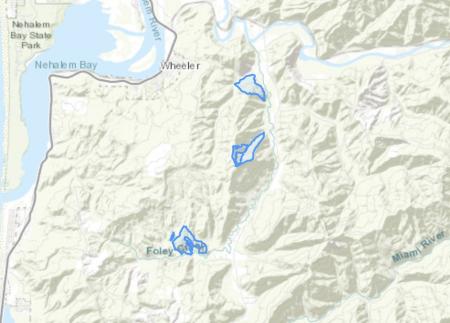
On Sept. 9, 2026, the Oregon Department of Forestry notified the public of a planned application of Rozol in private timber land in Tillamook County. Rozol is a rodenticide used to kill rats, mice, prairie dogs, and in this case, mountain beavers.
Rozol (active ingredient chlorophacinone) will be applied in pellet form to 246.8 acres of recently-logged land near Wheeler.
What is a mountain beaver?
The mountain beaver, Aplodontia rufa, sometimes called a boomer, is not a true beaver. Rather than dams, it builds networks of tunnels. The mountain beaver plays an important role in the ecosystem. Its tunnels transport the mycorrhizae — that is, the crucial symbiosis between fungus and the roots of plants — throughout the forest. Its main diet is ferns, and it also eats small trees and other plants. Mycorrhizae play important roles in plant nutrition, soil biology, and soil chemistry. Today’s industrial forest practices are depleting the mycorrhizae, thus depleting the soil.
Who is applying the poison?
Stimson Lumber Company has notified the state that it plans to apply Rozol to these areas. This step is taken after clearcutting and before planting a new tree crop. The intention is to prevent mountain beavers from damaging the saplings. (Note that their other sources of food have all been removed during the harvest.)
Why is this of concern?
Rozol is an anticoagulant, meaning it prevents blood clotting and causes internal bleeding and death. If ingested, it is highly toxic to humans.
A study released by the National Institute of Health found that Rozol persists in the bodies of dead animals and remains a “secondary hazard” for two weeks or longer. The study notes: “Secondary toxicity in mammals and birds that consume animals containing residues of anticoagulant rodenticides represents a persistent conflict between conservation, agriculture and environmental contamination.” Cougars, mink, and great horned owls are among the animals that feed on mountain beavers.
Rozol is harmful to birds, bees, butterflies, and also dogs and cats.
The planned application includes multiple sites that are within 100 feet of streams and wetlands, including Foley Creek, which flows into the Nehalem River before reaching the Pacific Ocean near Wheeler, Oregon.
When is this happening?
The notice allows application at any time from 9/24/26 to 12/31/26.
It should be noted that this is a common forest management practice that is widespread in Oregon.
This image attached shows the three areas slated for Rozol application (source ODF).
Contacts:
Oregon Department of Forestry
Tillamook County Forester Erick Finnell
(503) 842-2545
erick.r.finnell@oregon.gov
Landowner
Stimson Lumber
(503) 357-2131
North Coast Communities for Watershed Protection
annemarie.nccwp@gmail.com
North Coast Communities for Watershed Protection wants no more logging and pesticide use in community water sources and an end to pesticide applications near where people live, work, and recreate.
rockawaycitizen.water@gmail.com | www.healthywatershed.org
Sources:
Oregon Department of Forestry, Forest Activity Electronic Reporting and Notification System (FERNS)
Pesticide Properties DataBase developed by the Agriculture & Environment Research Unit (AERU) at the University of Hertfordshire: sitem.herts.ac.uk/aeru/ppdb/en/Reports/146.htm
National Institutes of Health: pubmed.ncbi.nlm.nih.gov/25997570/
NCCWP wants no more logging and pesticide use in community drinking water sources regardless of who owns the land, and wants an end to pesticide applications near where people live, work, and recreate. Safe drinking water and clean air are part of the public trust that we all are entitled to have. Please help North Coast Communities for Watershed Protection safeguard and restore our drinking watersheds.
For more information go to our website www.healthywatershed.org or contact rockawaycitizen.water@gmail.com.