Submitted By: swifter.05-firmest@icloud.com – Click to email about this post
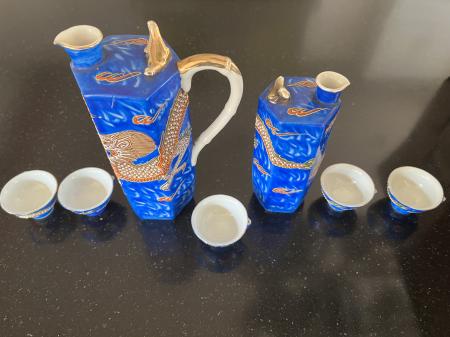
Rare Pre-1941 Set of two ‘Whistling Bird’ Tokkuri sake set vessels with 5 whistling cups- the set is a bright blue with hand made moriage dragon on the pieces
- when the sake or tea is poured the gold bird on the top of the pitcher whistles as do the cups
- the larger 6 sided pitcher is 18 cm (7”) high and the smaller six sided pitcher is 15 cm (6 inches) high x 5.5 cm diameter base
- the tray is 19 cm (7.5 inches) in diameter
- the cups stand 3.5 cm high x 5 cm diameter across the rim
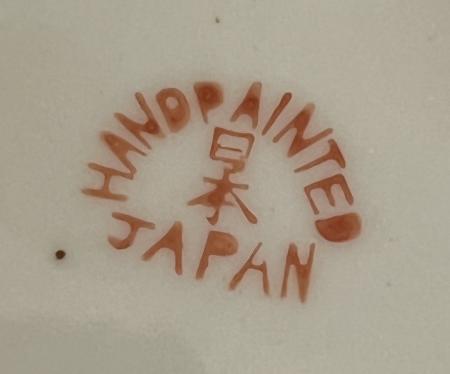
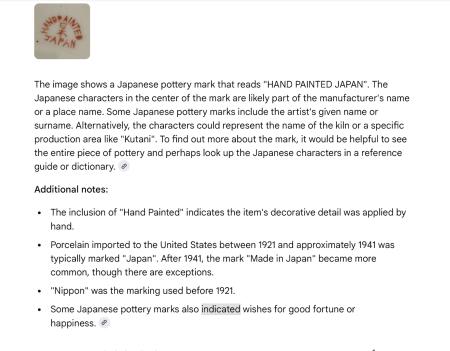
- the whole set is in excellent condition This is a whistling cup – when you drink and suck in air through the hole on the side, the cup whistles. From 1921-1941, wares from Japan exported to the United States had to be marked “Japan” or “Made in Japan” The image displays a backstamp or mark on a piece of Japanese porcelain, likely from a tea set, featuring the words “HANDPAINTED JAPAN” and the Japanese characters for “Japan” (日本) in the center.
* This mark is commonly found on vintage Japanese porcelain, particularly on items like Kutani Moriage Dragonware tea sets. * “Moriage” refers to a decorative technique where raised enamel is applied to create a three-dimensional effect, often seen in the dragon motifs on these pieces. * The inclusion of both English and Japanese script in the mark was common on items produced for export to Western countries. * These tea sets, often featuring intricate designs like dragons and sometimes lithophane geisha figures in the cups, were popular in the early to mid-20th century. * the presence of two large vessels in this prewar sake set suggests they are likely Tokkuri, which are sake flasks used for serving. * Here are a few possible reasons why the set might include two Tokkuri: * Serving Warm Sake: One Tokkuri can be used to warm sake in a water bath while the other is used for pouring. This allows for a continuous flow of warm sake. * Convenience: Having two Tokkuri allows for a quick replacement once the first is empty, preventing interruptions during a meal or gathering. * Large Gatherings: the prewar sake set was designed for serving multiple people, two Tokkuri would be necessary to hold and serve enough sake for everyone. * Cultural Significance: Sake has long held cultural importance in Japan, with ceremonies and gatherings often involving the consumption of sake. Having multiple vessels would be beneficial for these occasions. * While not explicitly mentioned as a standard for prewar sets, some older sets might have been designed with multiple Tokkuri for these practical reasons. * It’s also worth noting that the shape and size of Tokkuri can vary, with larger flasks allowing the sake to warm more slowly. This might also contribute to the size of the vessels in this set. I bought this set in 1988 from the widow of an Army veteran who was stationed in Japan in 1946. He brought this set back from Japan.
Located in Manzanita
$250 or reasonable offer Please reply to this email address
Thanks, BBQ!
* This mark is commonly found on vintage Japanese porcelain, particularly on items like Kutani Moriage Dragonware tea sets. * “Moriage” refers to a decorative technique where raised enamel is applied to create a three-dimensional effect, often seen in the dragon motifs on these pieces. * The inclusion of both English and Japanese script in the mark was common on items produced for export to Western countries. * These tea sets, often featuring intricate designs like dragons and sometimes lithophane geisha figures in the cups, were popular in the early to mid-20th century. * the presence of two large vessels in this prewar sake set suggests they are likely Tokkuri, which are sake flasks used for serving. * Here are a few possible reasons why the set might include two Tokkuri: * Serving Warm Sake: One Tokkuri can be used to warm sake in a water bath while the other is used for pouring. This allows for a continuous flow of warm sake. * Convenience: Having two Tokkuri allows for a quick replacement once the first is empty, preventing interruptions during a meal or gathering. * Large Gatherings: the prewar sake set was designed for serving multiple people, two Tokkuri would be necessary to hold and serve enough sake for everyone. * Cultural Significance: Sake has long held cultural importance in Japan, with ceremonies and gatherings often involving the consumption of sake. Having multiple vessels would be beneficial for these occasions. * While not explicitly mentioned as a standard for prewar sets, some older sets might have been designed with multiple Tokkuri for these practical reasons. * It’s also worth noting that the shape and size of Tokkuri can vary, with larger flasks allowing the sake to warm more slowly. This might also contribute to the size of the vessels in this set. I bought this set in 1988 from the widow of an Army veteran who was stationed in Japan in 1946. He brought this set back from Japan.
Located in Manzanita
$250 or reasonable offer Please reply to this email address
Thanks, BBQ!